A Cyber Security Professional and CEO of
'Cyber Community 01' with expertise in multiple
security domains like Offensive Security, Defensive Security,
AI in Cybersecurity, ML for Cybersecurity, Anomaly Detection,
Threat Prediction, Network Security, Cryptography and Privacy
and Governance.
Offensive SecurityDefensive SecurityAI in CybersecurityML / Anomaly DetectionCryptographyPrivacy & Governance
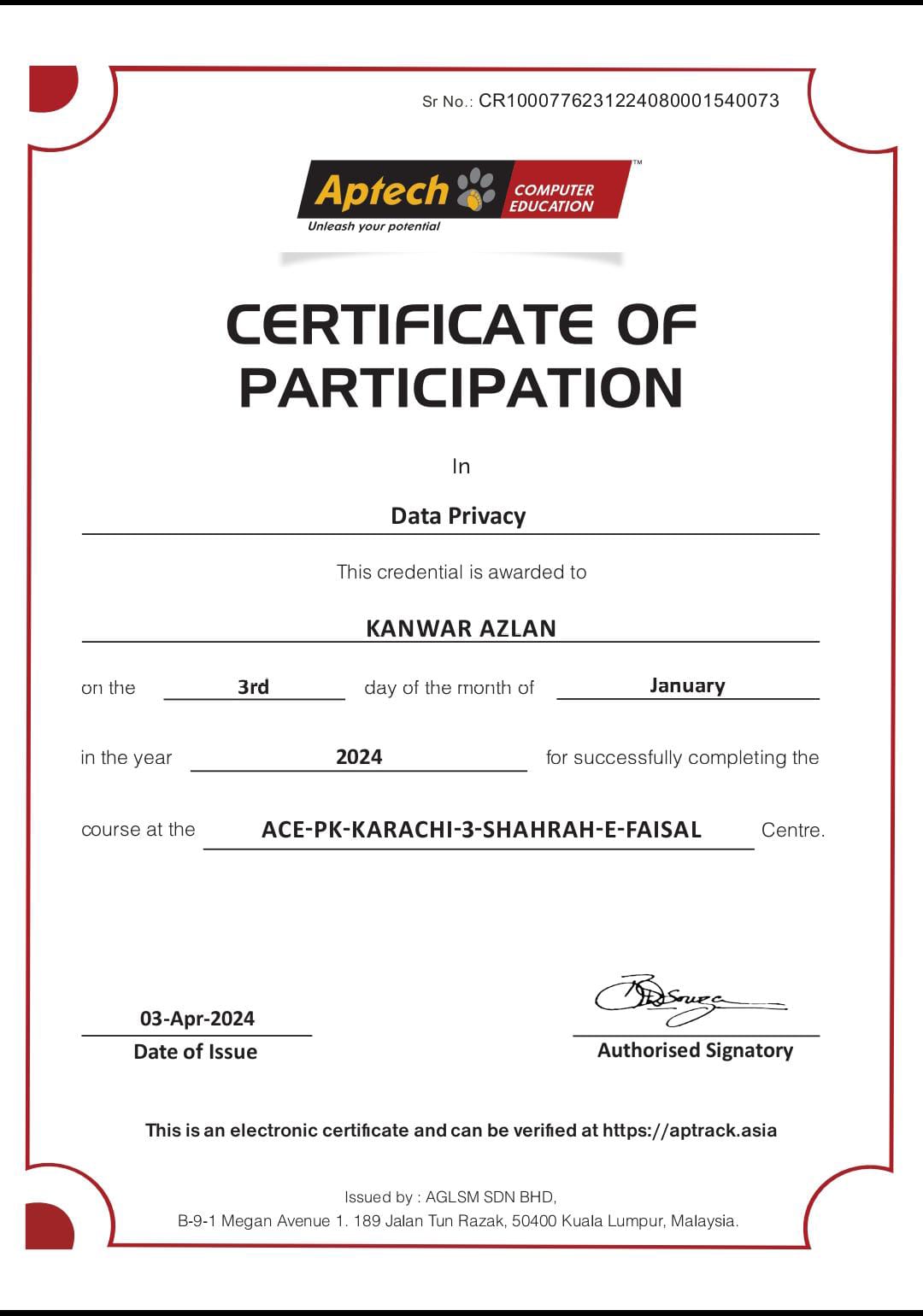
Mr. Kanwar Azlan is currently enrolled in PhD in Information Security at National University of Science and Technology (NUST).
Photo to be attached
Dr. Kanwar Azlan
PhD Information Security
Second Position
Silver Medallist
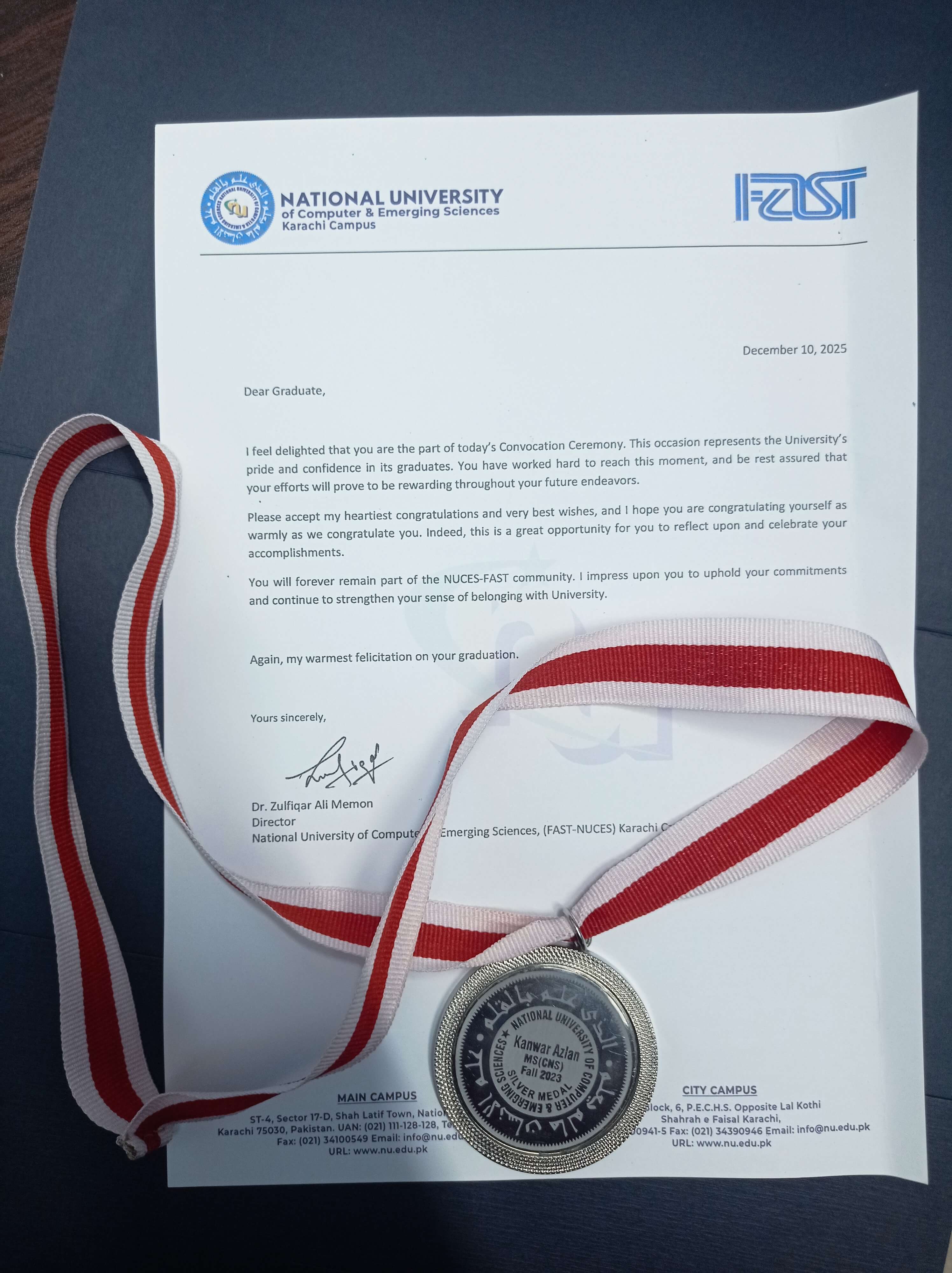
Mr. Kanwar Azlan has been awarded with a Silver Medal as he secured the Second Position in Masters in Cyber Security at the 88th Convocation Ceremony of FAST National University.
Mr. Kanwar Azlan MS Cyber Security
Masters Degree (MS CS)
Mr. Kanwar Azlan has completed his Master's Degree in Cyber Security.
Institution: FAST National University of Computer and Emerging Sciences
Location: Karachi, Pakistan
Year: 2025
Areas of Expertise
Computer Networks and SecurityCyber SecurityApplied Information SecurityMachine Learning for CybersecurityCloud ComputingAI in Cybersecurity
Master's Thesis
Topic: Real-Time Detection and Prediction of zero-day attacks in Network Traffic using Ensemble Unsupervised Learning.
Research Interest
Network SecurityAI & ML for CybersecurityNetwork MonitoringFeature EngineeringZero-day AttacksEnterprise NetworksThreat Detection
Bachelor's of Science
Computer Science
Mr. Kanwar Azlan has been awarded the Degree of Bachelor's of Science in Computer Science at the Convocation Ceremony of NED University of Engineering and Technology.
Mr. Kanwar Azlan BS Computer Science
Bachelors Degree (BS CS)
Mr. Kanwar Azlan has completed his Bachelor's Degree in Computer Science.
Institution: NED University of Engineering and Technology
Location: Karachi, Pakistan
Year: 2023
Areas of Expertise
Data Communication and NetworkingInformation SecurityDatabase Management SystemsOperating SystemsArtificial IntelligenceProgramming (Python & C/C++)
National University of Science and Technology (NUST)
Jan 2026 – Present
Direct and oversee the Cyber Security Zone research lab, managing technical infrastructure, resource allocation, and daily operations to support advanced security experimentation.
Serving as the primary liaison for the Project/GEC Committee, streamlining internal communications through dedicated channels to manage work progress, project status updates, and meeting schedules.
Curate and disseminate high-level technical intelligence, including emerging threat reports and industry-relevant articles, to ensure team alignment with the latest cybersecurity trends.
Responsible for maintaining project timelines and organizational agility by facilitating regular status syncs and coordinating multi-disciplinary team efforts.
Directing a high-level research initiative focused on cryptography and AI/ML threat detection in complex network environments.
Technical Project & Research Lead - Cyber Security
FAST National University of Computer and Emerging Sciences
March 2025 – Present
Developed an ensemble learning unsupervised framework with state-of-the-art techniques for zero-day attack detection in network traffic.
Successfully led a 5 members team including software developers and supervisors.
Detected multiple zero-day attacks in network traffic with the accuracy rate up to 80%.
Approved a Funded Research Support Grant (FRSG), from FAST National University, Pakistan.
Secured industry funding and MoU Signing through FAST National University, aligning research with real-world security needs.
Completed the project 3 months ahead of schedule, accelerating evaluation and enabling early publication.
Authored a Project Management Report (PMO) for industry partners and stakeholders.
Cybersecurity Internee
Code Alpha Pvt. Ltd.
Dec 2024 – March 2025
Discovered and documented 7+ critical and 13 medium risk vulnerabilities during the penetration testing of Android mobile App "AndroGoat".
Investigated, exploited the critical vulnerabilities including Misconfiguration, Unauthorized certificate installation, exposed database and documented the findings in the Statistic Analysis Report.
Conducted an online awareness session on phishing attacks and it's importance, possible risks and mitigation strategies to educate the employees and stakeholders.
Cybersecurity Internee
Kairiz Cyber Technology SMC Pvt. Ltd.
June 2024 – July 2024
Designed and deployed a simulated small business network: Kali Linux (Host), Ubuntu (Server/Workstation), Metasploit and Wazuh (Client). Made the asset inventory of the whole network system.
Applied NSE scripts to extract the detail or hidden information about the specific IP address. Also, Identified hidden ports using aggressive network scanning.
Simulated real-world threat scenarios aligned with the NIST cybersecurity framework (Identify–Protect–Detect–Respond–Recover).
Spotted 13+ high-risk and 30+ medium-risk vulnerabilities across the network system.
Successfully exploited an FTP server by capturing traffic and leveraging default credentials.
Applied Security Triggers and Alerts for monitoring using Wazuh Agents for future security incidents.
Data Privacy Internee
Habib Bank Limited - HBL
Feb 2024 – March 2024
Assessed and identified violation of security laws in terms of privacy in robotic process automation (RPA).
Provided suggestions for making the RPA systems, GDPR Compliant that helps to manage and secure the data efficiently.
Identified operational and functional risks in compliance to privacy laws and standards like GDPR, HIPPA, ISO 27001.
Provided 1-pager report and presentation mentioning risks, security threats and mitigation strategies.
Cybersecurity Internee
Senseleaner Technologies Pvt Ltd.
Sep 2023 – Oct 2023
Performed vulnerability analysis, network scanning, foot printing and reconnaissance using tools like OSNIT, NMAP, NSE, OpenVas, Nessus and Metasploit.
Outlined a detailed report including the vulnerabilities discovered and recommendation for the future security enhancements.
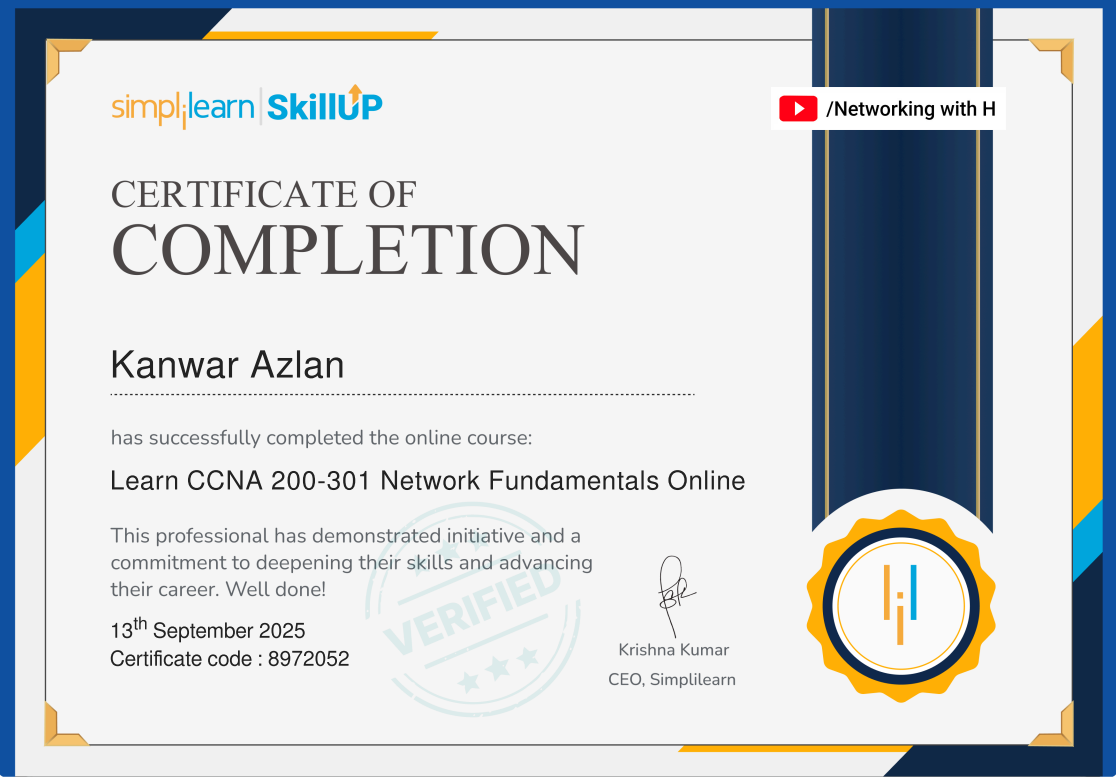
Skills: Network Fundamentals, Security fundamentals, Troubleshooting, Automation and programmability, Network access, Network security, Wireless network, IPv6 addressing, Network Administration, Linux, Network infrastructure design, Networking, OSPF, Router configuration and management, Routing and Switching, Cisco IOS commands, Ip connectivity, Ip connectivity, Ip services, IPv4 addressing, Native VLAN, Routers, Network switch, Virtualization fundamentals
Credential ID: 8972052
Year: 2025
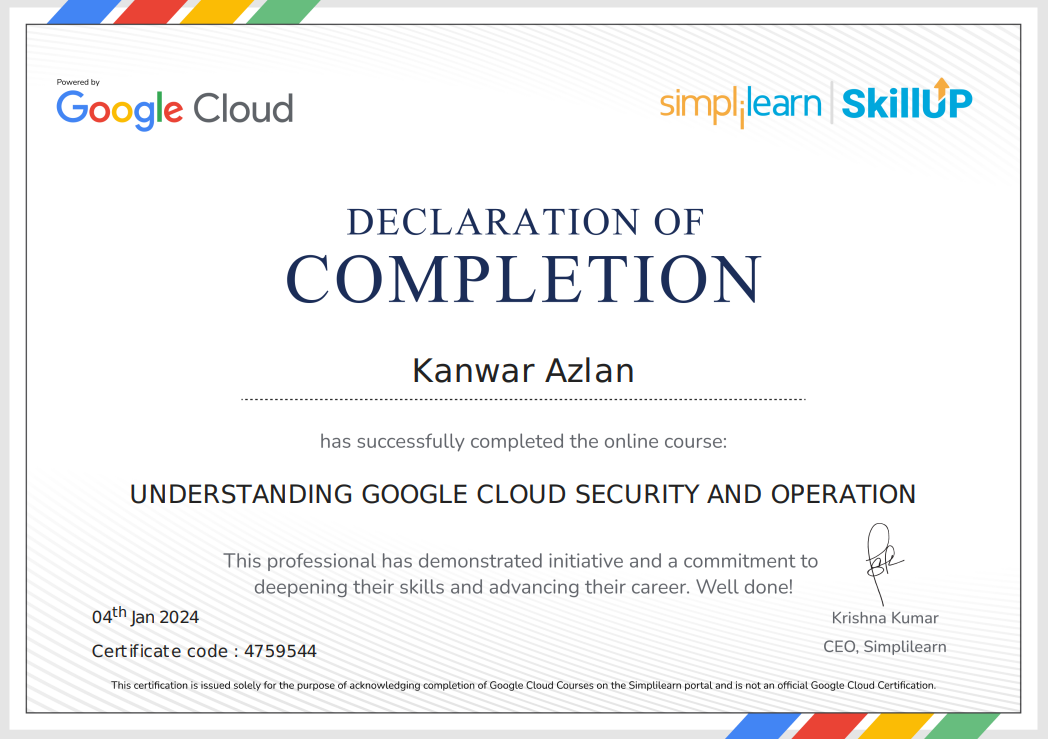
Understanding Google Cloud Security and Operations
By Google Cloud
Skills: Google Cloud Security Architecture, Identity and Access Management (IAM), Network Security and Firewalls in GCP, Data Protection and Encryption, Security Monitoring and Logging, Incident Response and Threat Detection, Compliance and Governance, Workload and VM Security, Service Account and API Security, Operational Best Practices for Cloud Security
Credential ID: 4759544
Year: 2024
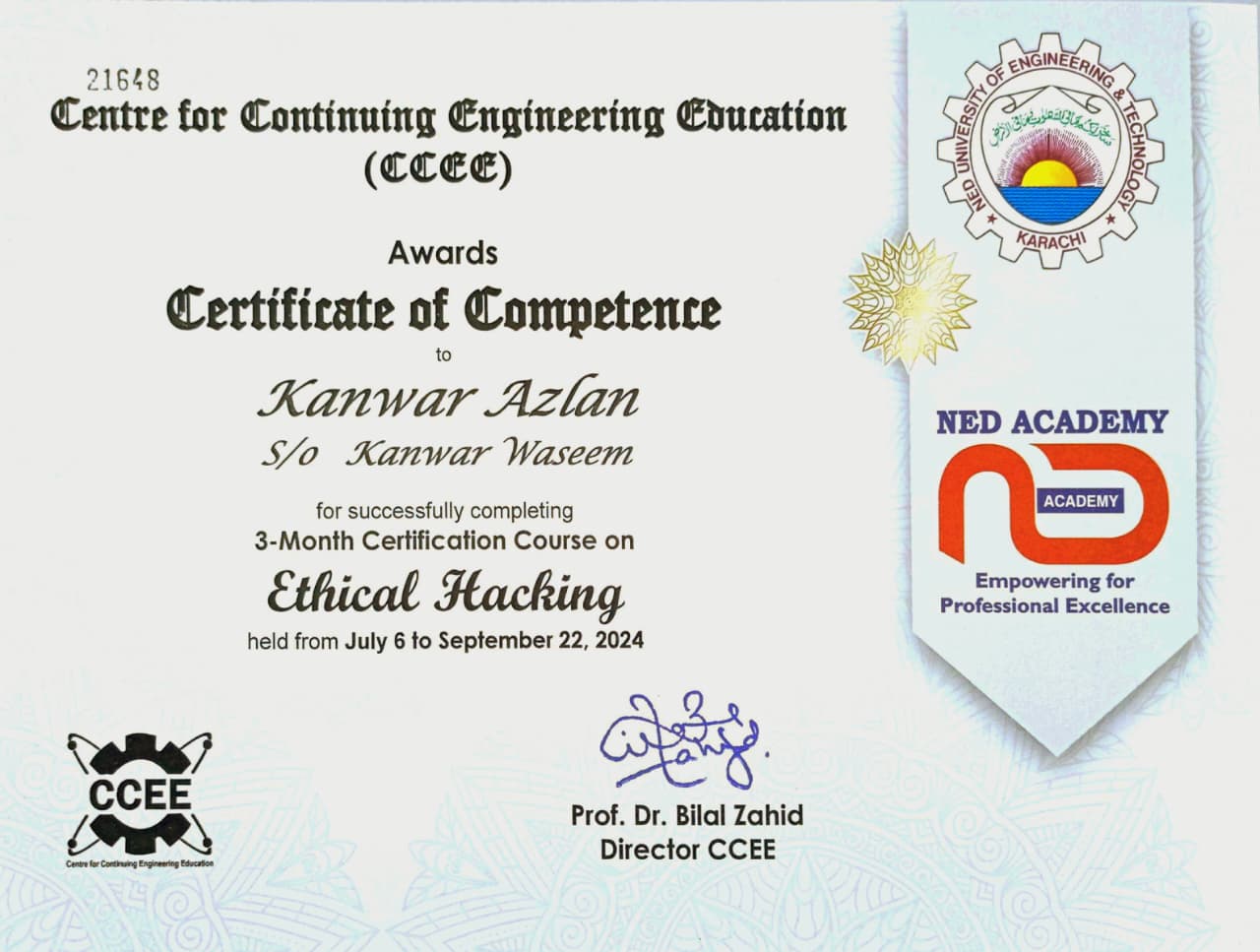
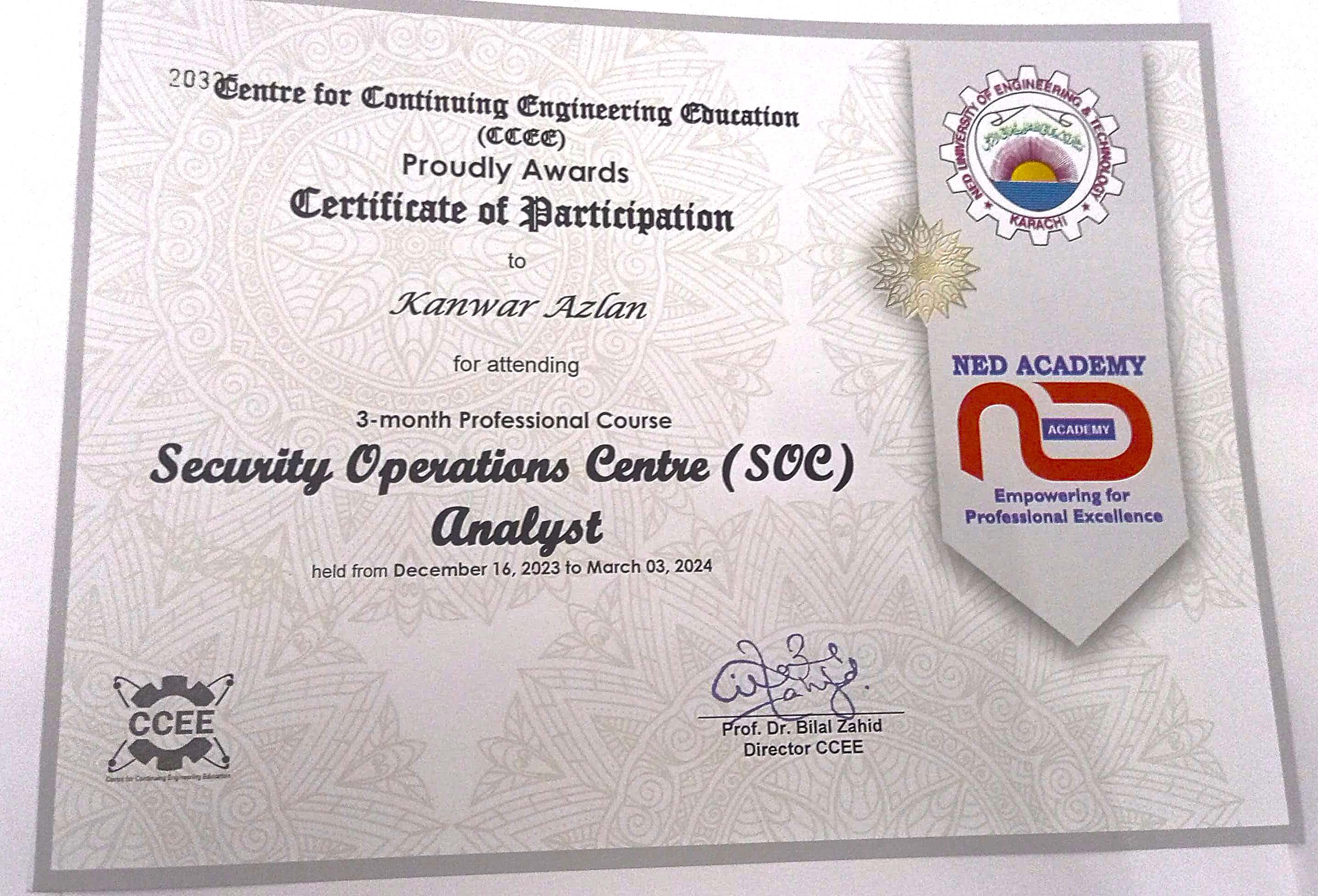
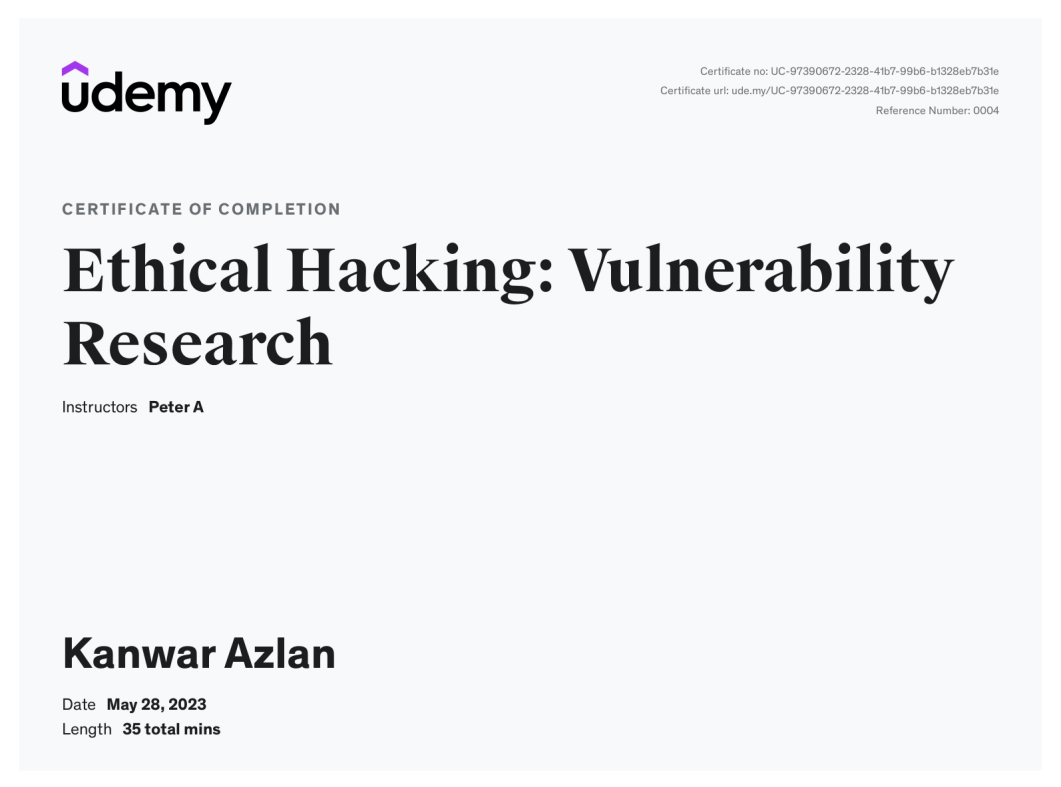
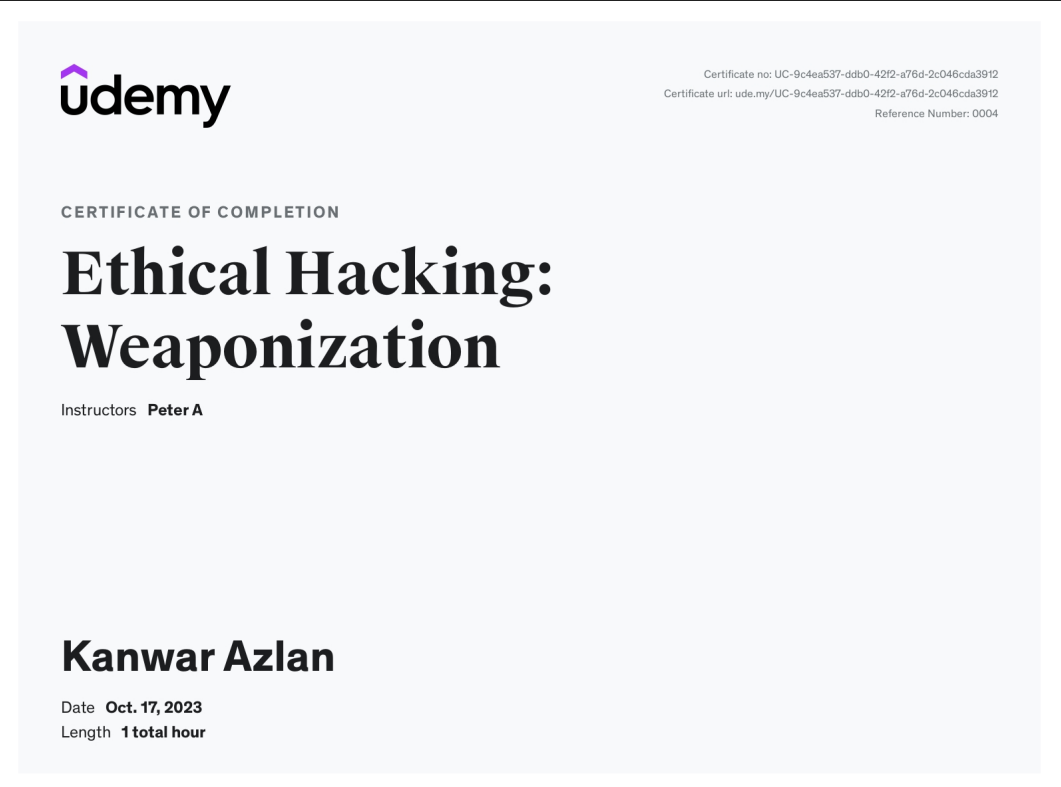
Certified Ethical Hacking (CEH)
By NED University of Engineering and Technology
Skills: Networking, Penetration testing, Cryptography, Social engineering, Operating Systems, Analytical thinking, Linux skills, Reverse engineering, Web applications, Communication, Hardware knowledge, Certified Ethical Hacker, Cloud security, Malware, Mobile hacking, Network security, Wireless network understanding, Wireless technologies, Attention to detail, Bug bounty, Programming skills, Scripting, Ethical and legal knowledge
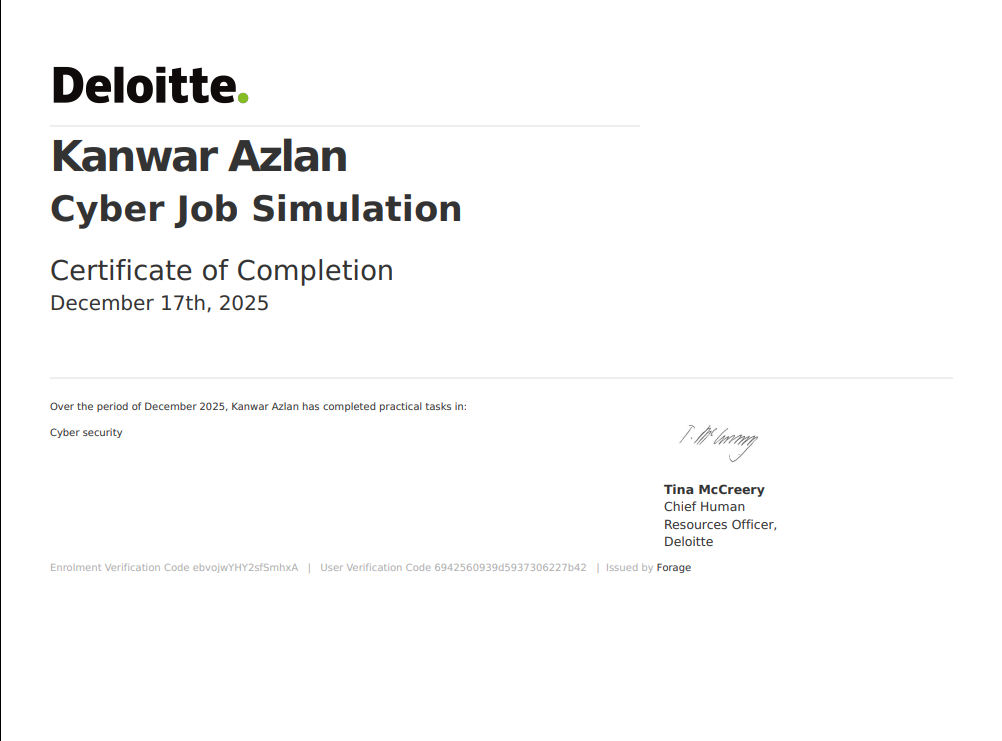
Skills: Real world Cyber Incident, Analysis and Reporting, Reading Network Log files, Finding suspicious IPs, Real-time job incident, Incident response
Credential ID: 894256093905937306227b42
Year: 2025
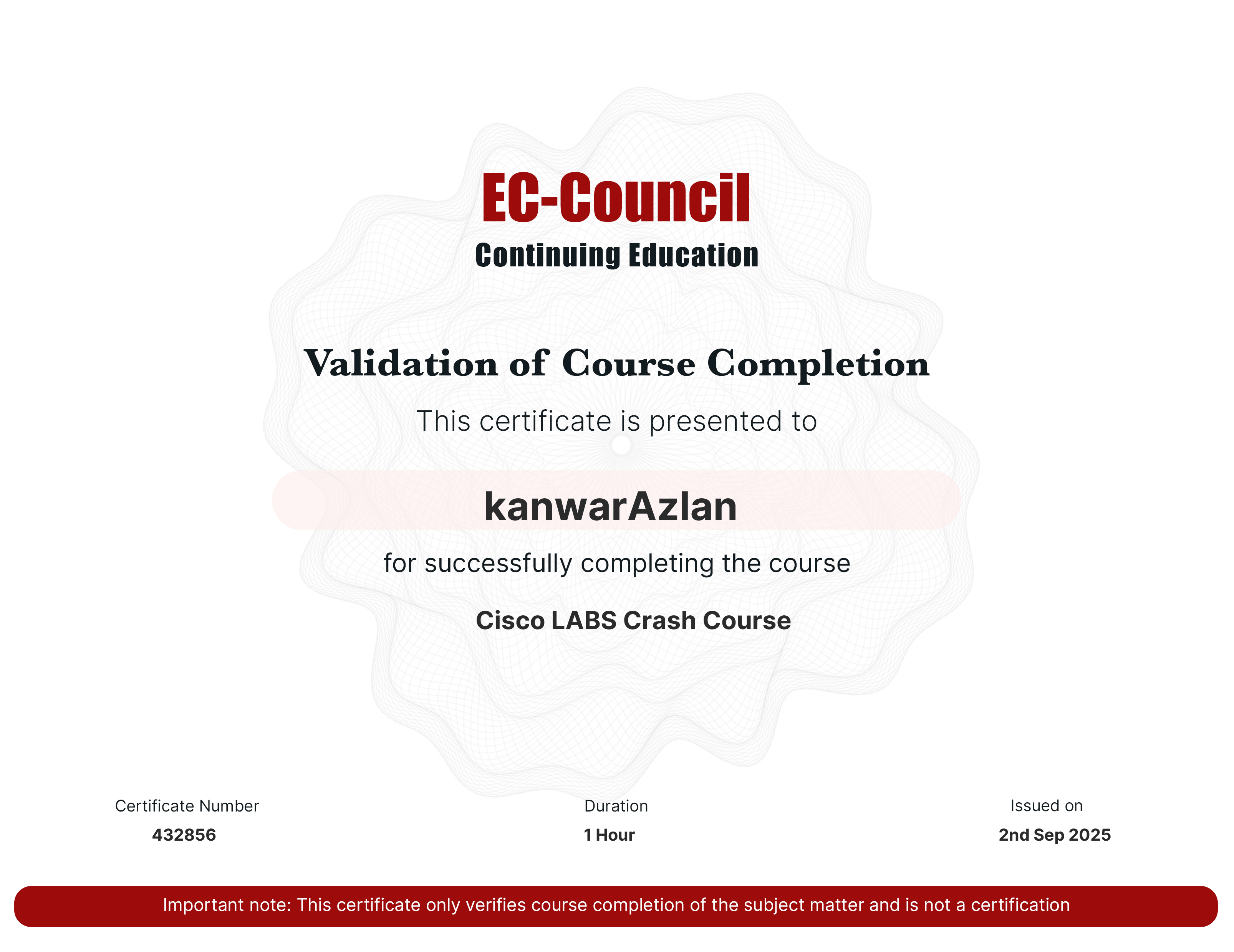
Cisco Labs
By EC-Council
Skills: Cisco Routers, DHCP, Cisco IOS, Port Address Translation (PAT), Networking, Router configuration, Network Devices, Server, Local Area Network (LAN), Lab Experimentation, Basic Networking Skills
Credential ID: 432856
Year: 2025
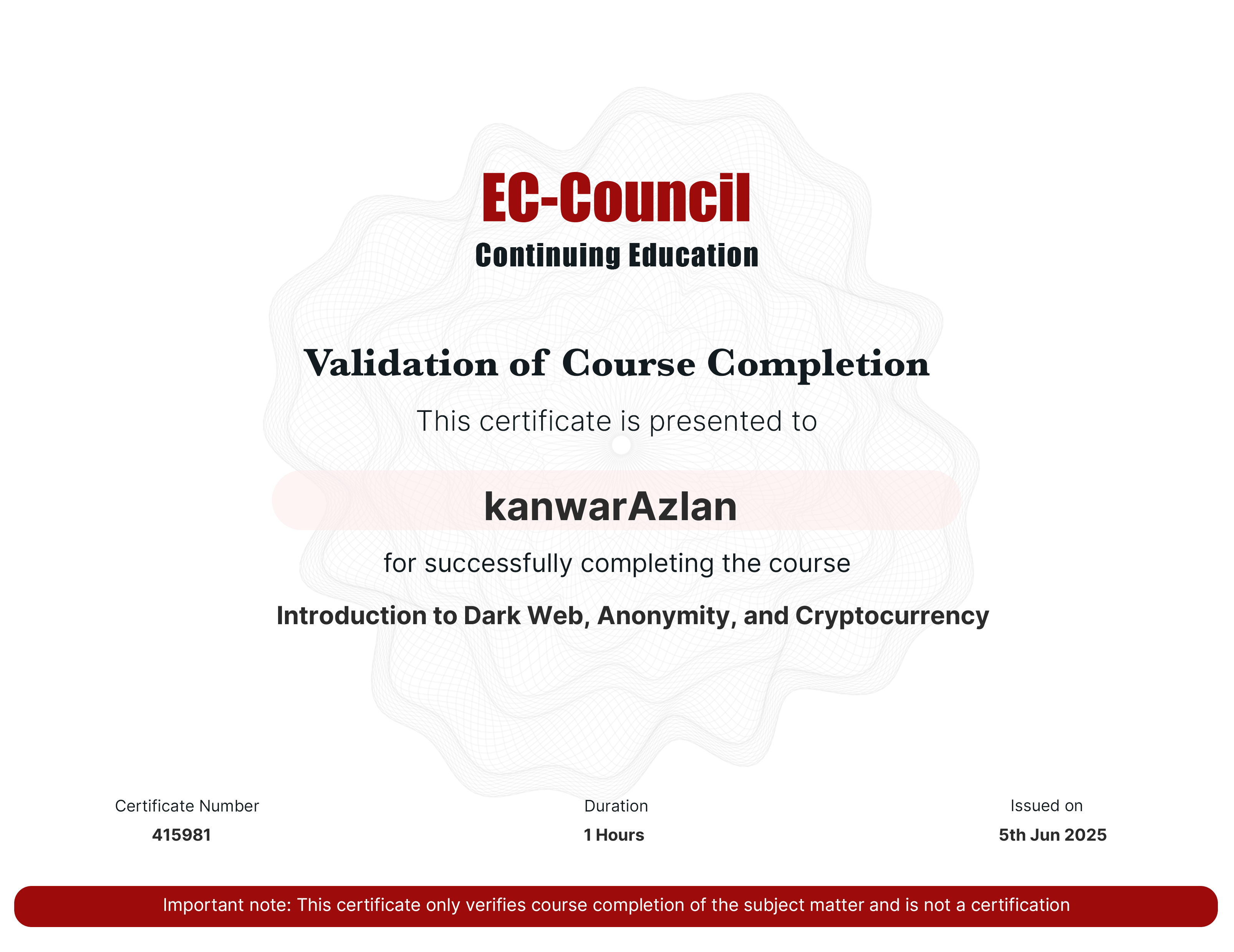
Introduction to Dark Web, Anonymity and Cryptocurrency
By EC-Council
Skills: Dark Web, Onion Routing, Layer Security, To be Anonymous, Safety Measures, Proxychains, Tor Browser, Onion Services, Cryptocurrency, Blockchain, secure online transaction, Bitcoin, Kali Linux installation, Windows 10 installation, Experimentation, How to Access Dark Web Securely.
Credential ID: 415981
Year: 2025
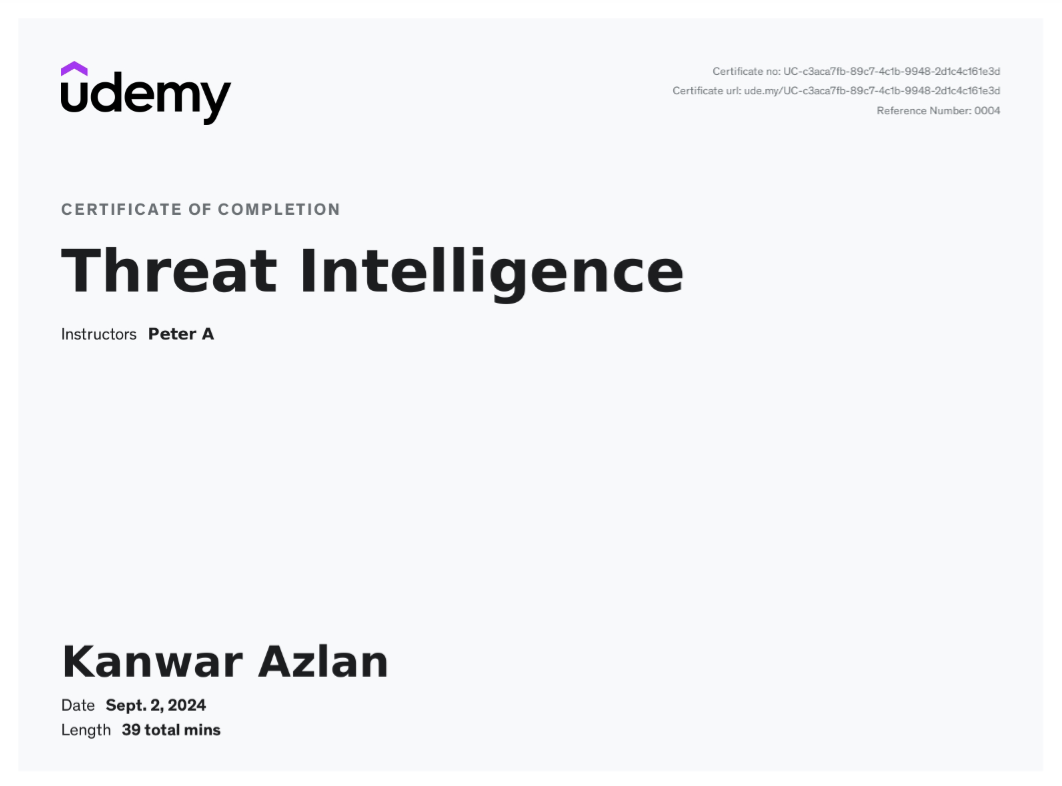
Threat Intelligence
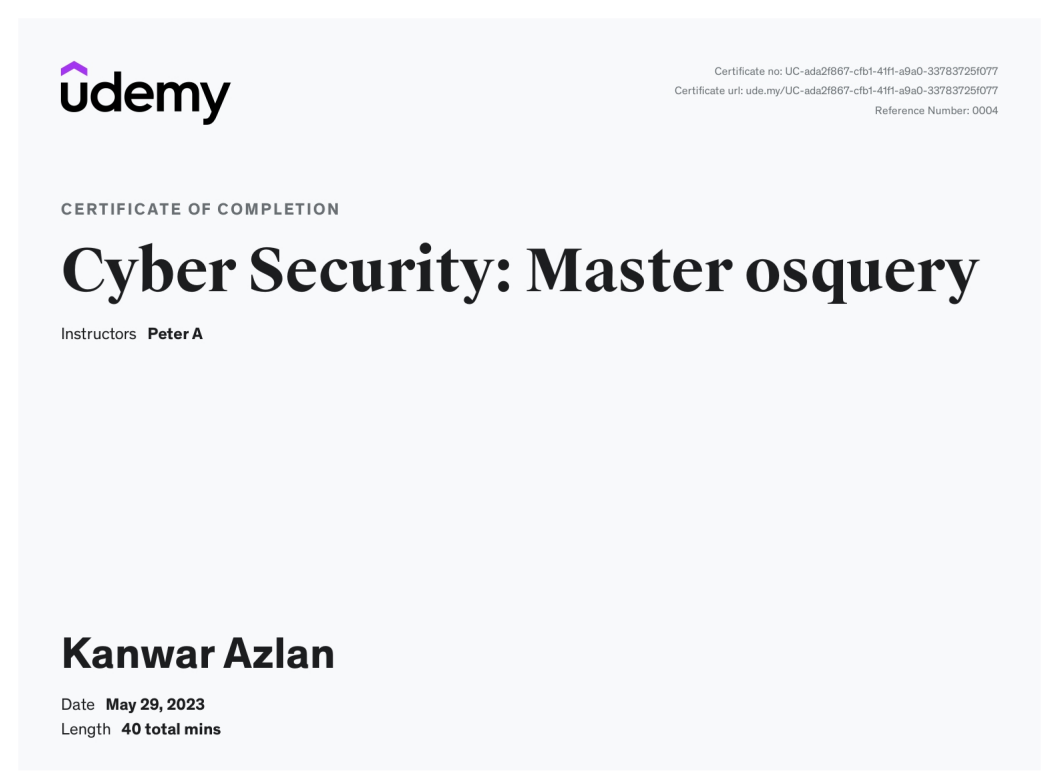
By Udemy
Skills: Analyze malicious links, Block botnets, Scan webpages, Threat Intelligence Dashboards, Attacker Behavior, Threat Intel tools, Data Driven Security, proactive to mitigate attacks, scan urls for malicious software, use threat intelligence tools and botnets, malware databases
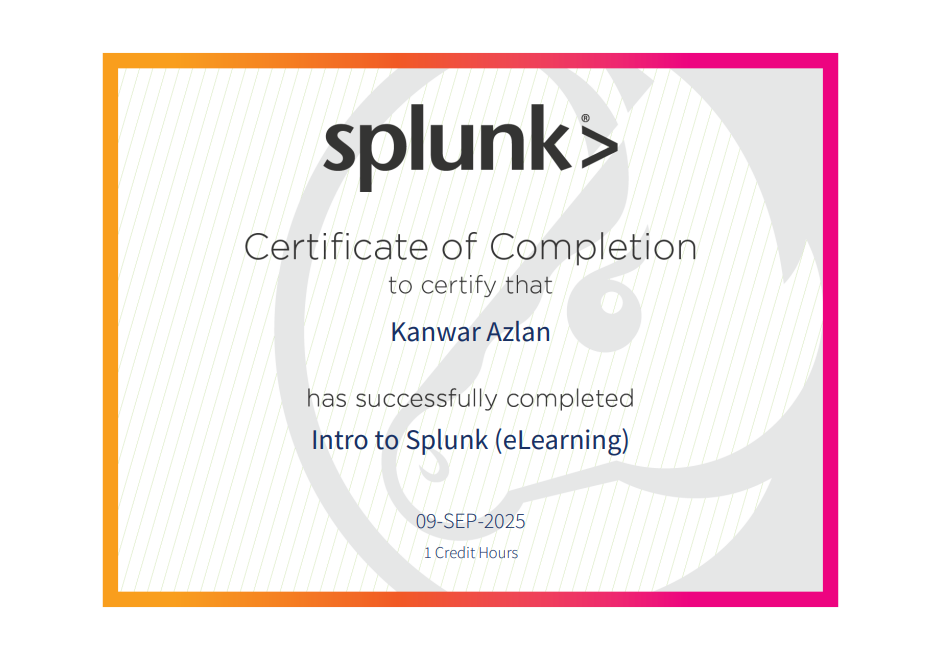
Skills: Configuring splunk networking, Data management, Basic networking knowledge, Comparing values, Creating field extractions, Creating knowledge objects, Data visualization, Enriching data with lookups, Intro to dashboards, Result modification, Scheduled reporting, Search under the hood, Splunk administration and advanced topics, Splunk web introduction, Statistical processing
Credential ID: --
Year: 2025
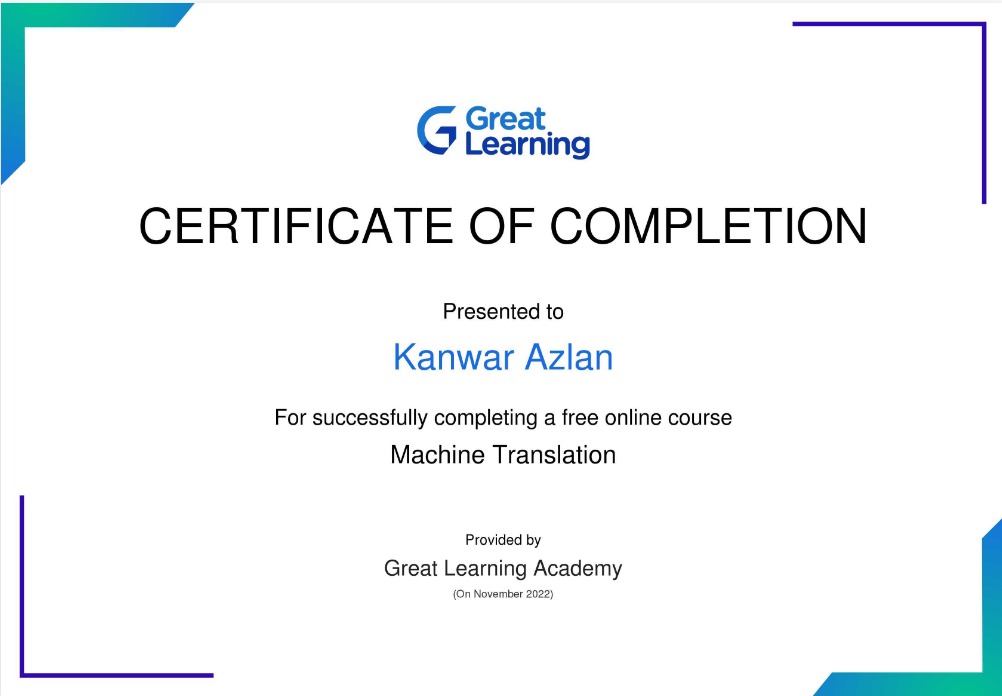
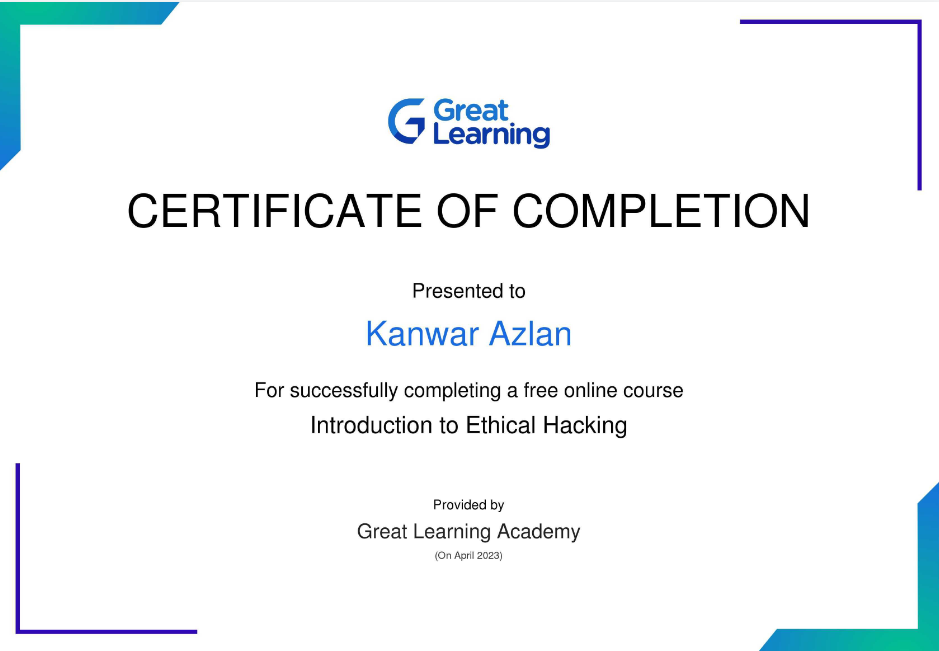
Machine Translation
By Great Learning Academy
Skills: Proficiency in natural language processing (NLP), statistical machine learning, deep learning, Linguistic skills include advanced fluency in multiple languages, strong writing abilities, and research skills to evaluate and post-edit translations
Technical Projects involves expertise that developed during professional experience, coding practices, IT and software development or system integrations
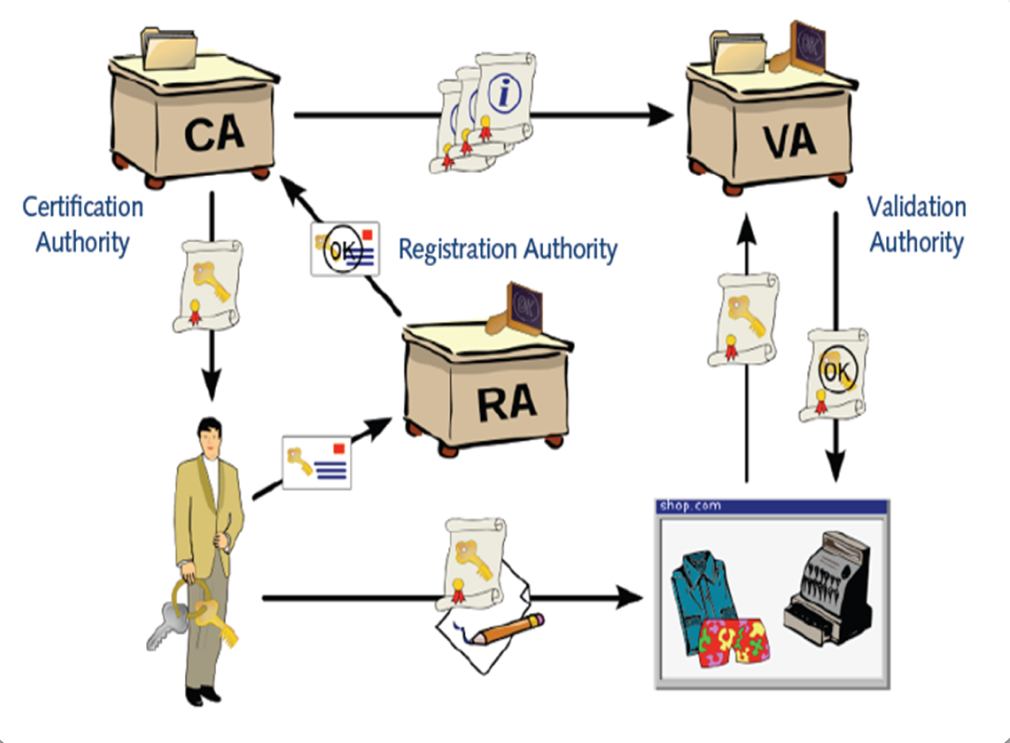
Develop a deeper comprehension of PKI and its critical role in Internet security.
Learn how PKI is integrated into web services to ensure secure communications.
Gain practical skills in setting up and managing digital certificates within a PKI framework.
Analyse and understand the implications of trust within the PKI system and the potential issues if this trust is violated.
Overview:
Public key cryptography is the foundation of today's secure communication, but it is subject to man-in-the-middle attacks when one side of communication sends its public key to the other side. The fundamental problem is that there is no easy way to verify the ownership of a public key, i.e., given a public key and its claimed owner information, how do we ensure that the public key is indeed owned by the claimed owner? The Public Key Infrastructure (PKI) is a practical solution to this problem. By doing the tasks, we should be able to gain a better understanding of how PKI works, how PKI is used to protect the Web, and how Man-in-the-middle attacks can be defeated by PKI.
Procedure:
Becoming a Certificate Authority (CA)
Creating a Certificate for SEEDPKILab2020.com
Deploying Certificate in an HTTPS Web Server
Deploying Certificate in an Apache-Based HTTPS Website
Launching a Man-In-The-Middle Attack
Launching a Man-In-The-Middle Attack with a Compromised CA
Description:
The core issue addressed is the verification of public key ownership: how to confirm that a public key indeed belongs to its claimed owner. PKI offers a practical solution to this verification problem. The project provides an in-depth understanding of how PKI functions, how it is utilized to enhance web security, and how it mitigates the risk of MITM attacks. Additionally, the project investigates the foundational trust within the PKI system and examines the potential consequences if this trust is compromised.
Skills:
Cryptography
Network Security
Web Server Management
System Administration
Problem Solving and Analytical Skills
Practical Application of PKI
Software Tools and Technologies
Security Best Practices
Collaboration and Documentation
Reference:
To get the full access of documents and the resources of the project, please visit the link below:
Bridging the Linguistic Barriers Between Countries. Professional translators have become an integral part of modern businesses because they help individuals and companies to expand their reach into new markets, by allowing them to speak to a particular target audience in their own dialect.
Improved Communication and Exchange of Ideas. Language translation services provide different parties with the ability to communicate and share ideas without a language barrier. Through translation, you can easily explain complex subject matters to another person in their native tongue.
Overview:
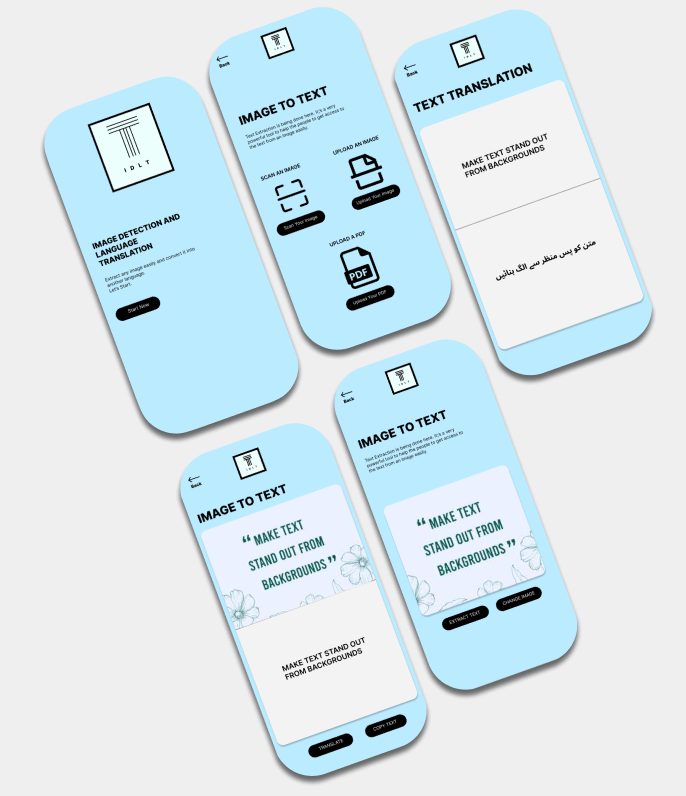
The main purpose to serve the people with an enhanced and useful application that brings them much faster as the world is growing. The project is basically allowing the user to enter the text in the source language and it will be translated into the target language. This is basically done by the image detection. First the user will scan the image containing some text. Then it will be converted into the readable text by the help of OCR (Optical Character Recognition). Then it will be translated into the target language by using a technique called NLP (Natural Language Processing).
Procedure:
First we have our main user interface (UI) or our main page that gives three options to the user that either user want to scan the image by opening the camera, or user can upload an image or user can upload PDF document.
Then firstly, our software extracts the text from the image by the help of OCR. It works at the back end by separating the colours of the image or pixels and background and foreground and then extract the text easily.
Now comes the main task of this App, this text is being converted to another language (Target language) by the help of NLP (natural language processing).
Description:
The main purpose to serve the people with an enhanced and useful application that brings them much faster as the world is growing. To capture the idea of dealing with the android application is chosen due to the vast and hands on experience of the users to the android app. As far as project idea is concern, it gives us the full exposure to use of two languages in parallel.
Skills:
AI and ML
Optical Character Recognition (OCR)
Natural Language Processing (NLP)
UI/UX Design
Project Development
Front and Back End Development
Reference:
To get the full access of documents and the resources of the project, please visit the link below:
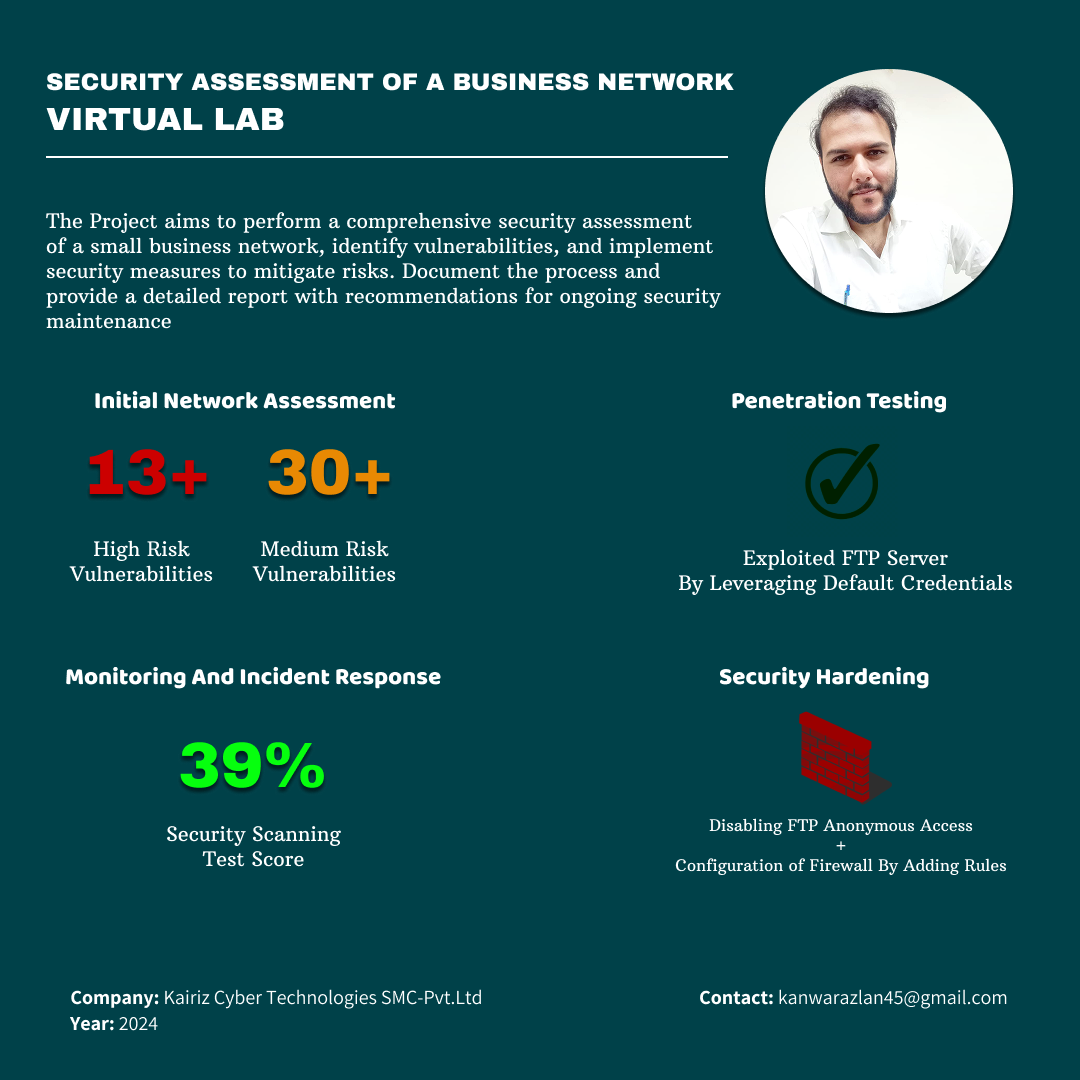
To assess the security of a business network with IoT devices, Servers and Clients.
Find vulnerabilities, exploiting them and perform security hardening.
To develop practical skills and hands-on experience in various aspects of cybersecurity including password cracking, vulnerability scanning, network scanning, web application penetration testing, and conducting comprehensive security assessments.
Overview:
This project will give a comprehensive understanding of various aspects of network security, from initial assessment and penetration testing to implementing security measures and developing incident response plans. Each task culminates in the documentation of the process and results, emphasizing the importance of meticulous record-keeping and reporting in cybersecurity.
Procedure:
The first task involves using Hashcat, a powerful password recovery tool, to crack hashed passwords.
The second task focuses on setting up and using OpenVAS for vulnerability scanning. We installed OpenVAS, perform initial scans on target IPs, and analyze the scan results to identify high, medium, and low severity vulnerabilities.
We used Nmap to perform network scans: identify live hosts, open ports, running services, and detect operating systems.
Final step involves using OWASP ZAP to test web applications for common vulnerabilities such as SQL injection, XSS, and CSRF. Focuses on establishing ongoing monitoring and incident response capabilities. A Security Information and Event Management (SIEM) system is set up to monitor network traffic, generate security events, with alerts configured for suspicious activities and potential incidents.
Description:
We map the network topology using tools like Nmap and Wireshark, perform vulnerability scans with OpenVAS or Nessus, and conduct penetration testing using tools like Metasploit and Burp Suite. The project includes implementing security measures such as network segmentation, patch management, and endpoint security, and developing an incident response plan. The project concludes with a detailed report and presentation of findings and recommendations to business stakeholders.
Skills:
Network Assessment
Penetration Testing
Network monitoring
Incident Response
Security Hardening
Reference:
To get the full access of documents and the resources of the project, please visit the link below:
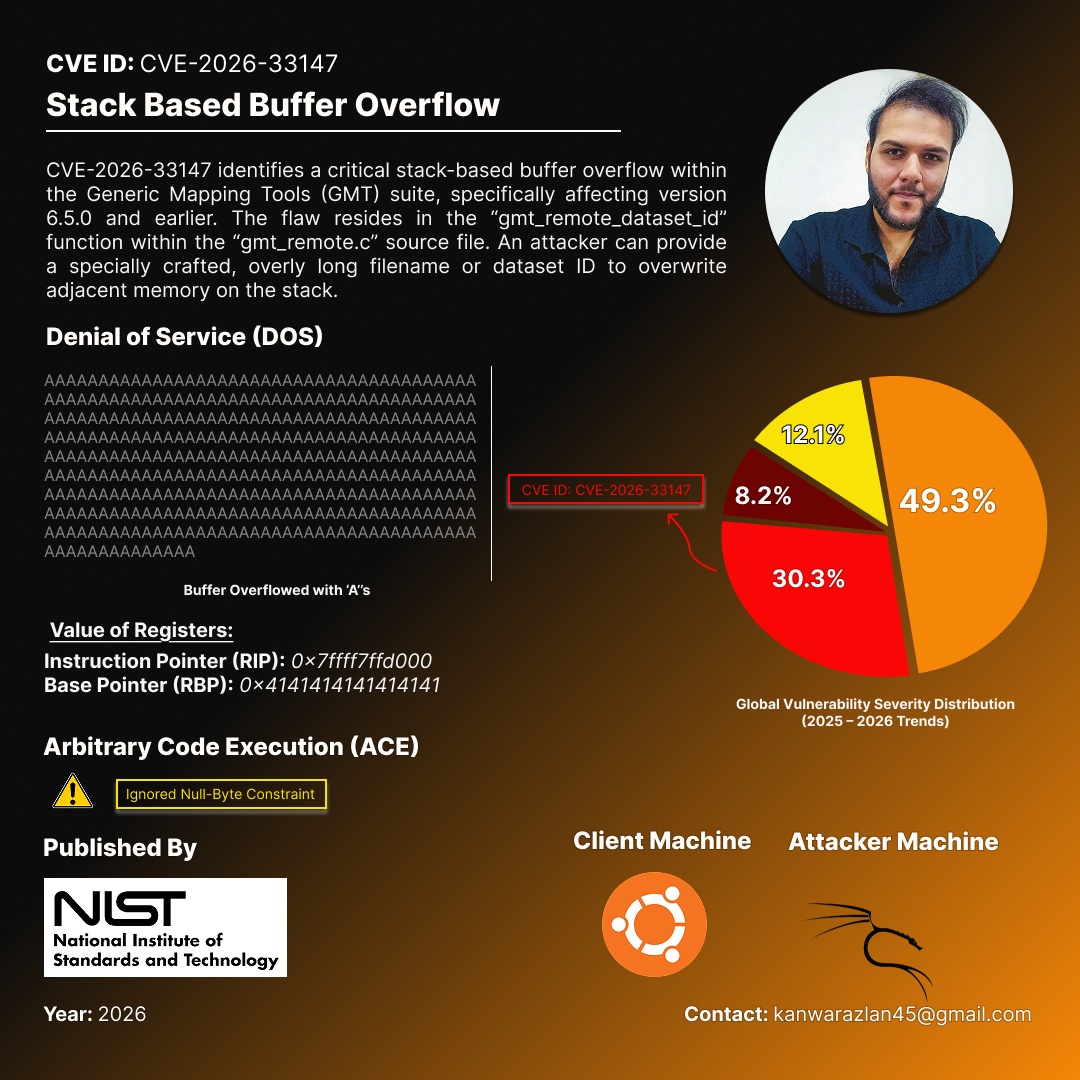
Replicate a real-world, high-severity stack-based buffer overflow (CVE-2026-33147) within a controlled environment.
Utilize debugging and exploit-generation tools to evaluate the feasibility of both Denial of Service (DoS) and Arbitrary Code Execution (ACE) attacks.
Observe the impact of compiling applications without standard security defenses like stack canaries and executable stack restrictions.
Checking whether the mitigation works for this vulnerability.
Overview:
Stack-based buffer overflow vulnerability discovered in the Generic Mapping Tools (GMT) suite (version 6.5.0 and earlier). Stemming from an unsafe strcpy function that fails to validate input lengths when processing remote dataset requests. This study successfully demonstrates how an oversized payload can trigger a Denial of Service (DoS) state. The 64-bit architecture null-byte limitations—encountered when attempting Arbitrary Code Execution (ACE), before conclusively verifying that the official development patch (Commit Dad2b49) fully mitigates the risk.
Procedure:
Set up a Kali Linux VM as the attacker machine and an Ubuntu VM as the victim machine.
Configure the network adapters of both virtual machines to 'Host-Only' mode to isolate the environment into a private local network.
Clone the official GMT repository.
Configure the build using CMake, explicitly passing flags to disable security features (–fno-stack-protector -z execstack), and compile the source code into executable binaries.
Generate a 5,000-byte payload consisting of padding characters ('A') on the Kali machine and host it via a local Python HTTP server.
Construct a malicious Python script (ace_exploit.py) configured with the calculated offset, custom Linux x64 shellcode (/bin/sh), and target stack addresses to output a weaponized binary payload (exploit.bin).
Re-run the binary against the malicious payload to verify that the application rejects the input safely and exits gracefully without crashing.
Description:
During execution of the vulnerable code path, passing an excessively long string to the gmt which module bypasses safe boundaries, allowing the overflow to alter memory positions where instructions are sequentially processed. While the architectural properties of 64-bit binaries restricted a full shell hijack in this demonstration due to null-byte constraints, the system's susceptibility to total service disruption highlights the criticality of replacing legacy functions like strcpy with safe alternatives that strictly enforce bounds checking.
Skills:
Vulnerability Assessment & Research
Exploit Development
Software Debugging & Memory Forensics
Secure Development & Remediation
Reference:
To get the full access of documents and the resources of the project, please visit the link below:
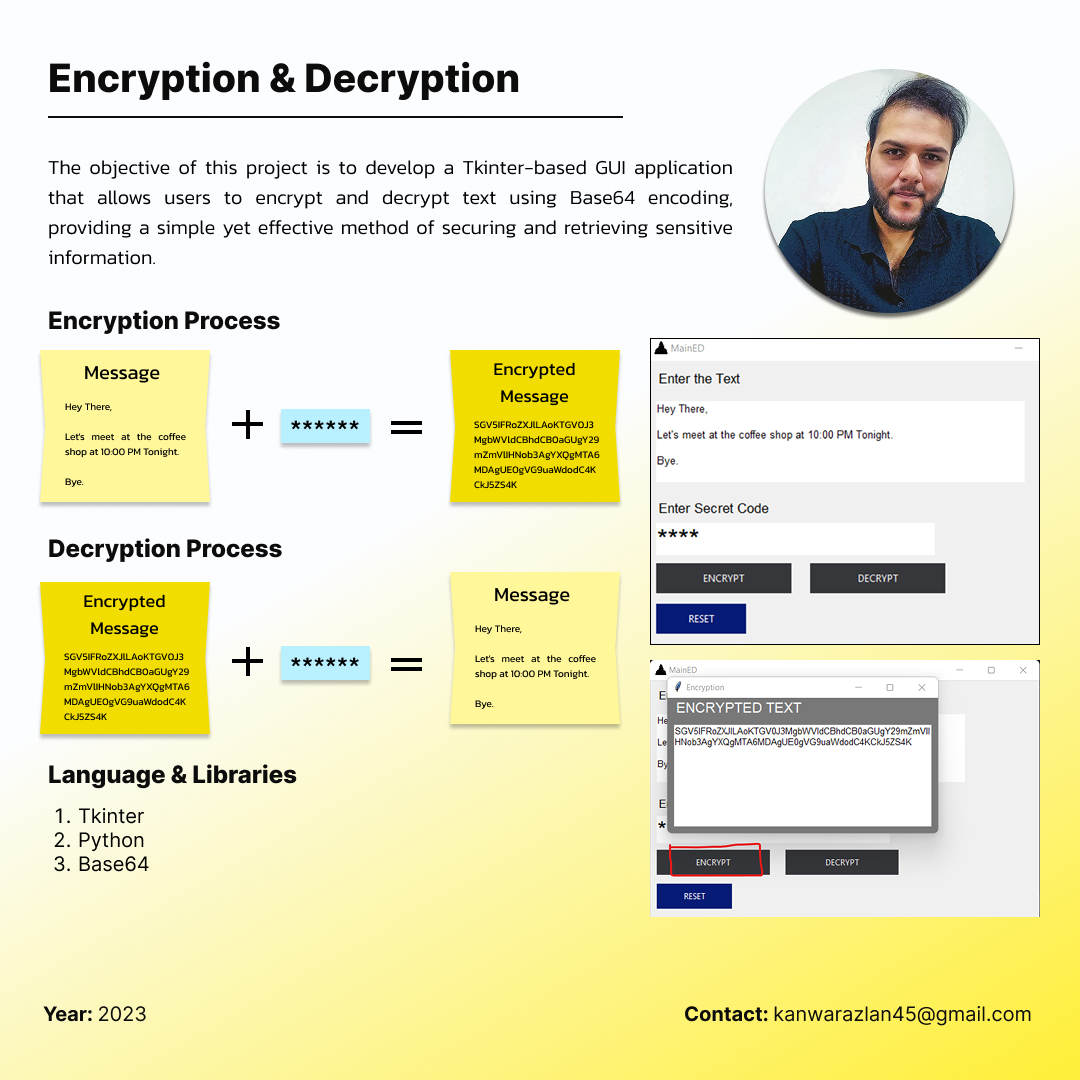
The objective of this project is to develop a Tkinter-based GUI application that allows users to encrypt and decrypt text using Base64 encoding, providing a simple yet effective method of securing and retrieving sensitive information.
Overview:
This project involves creating a Python application with a graphical user interface (GUI) using the Tkinter library. The application prompts users to enter text and a secret code. If the correct secret code is provided, users can encrypt the text into a Base64-encoded format or decrypt previously encoded text. The project demonstrates basic concepts of GUI programming, user input handling, and text encryption/decryption using Base64 encoding.
Procedure:
Enter the Input: When you run the app, enter the text you want to encrypt in plain text.
Enter the Secret Code: Now enter the secret password you set at the back end through coding.
Encrypt the Message: Now hit encrypt and you will be prompted with the encrypted Text.
Send Encrypted Text: Now send the text to someone.
Decryption of Text: The receiver will perform the same operation backward with the same secret code and it can decrypt the message.
Description:
The application has a main screen where users can input text and a secret code. Upon entering the correct code e.g ('1234'), users can choose to either encrypt the entered text or decrypt a previously encoded message. If the code is incorrect or missing, appropriate error messages are displayed. The encryption and decryption processes utilize Base64 encoding as a basic operation, which converts text to a secure format and then decodes it back to the original form. This project provides a practical application of Python programming and GUI development skills.
Skills:
Python Programming
GUI Development
T kinter - GUI Version
Text Encoding/Decoding
Error Handling
User Input Handling
Modular Programming
Reference:
To get the full access of documents and the resources of the project, please visit the link below:
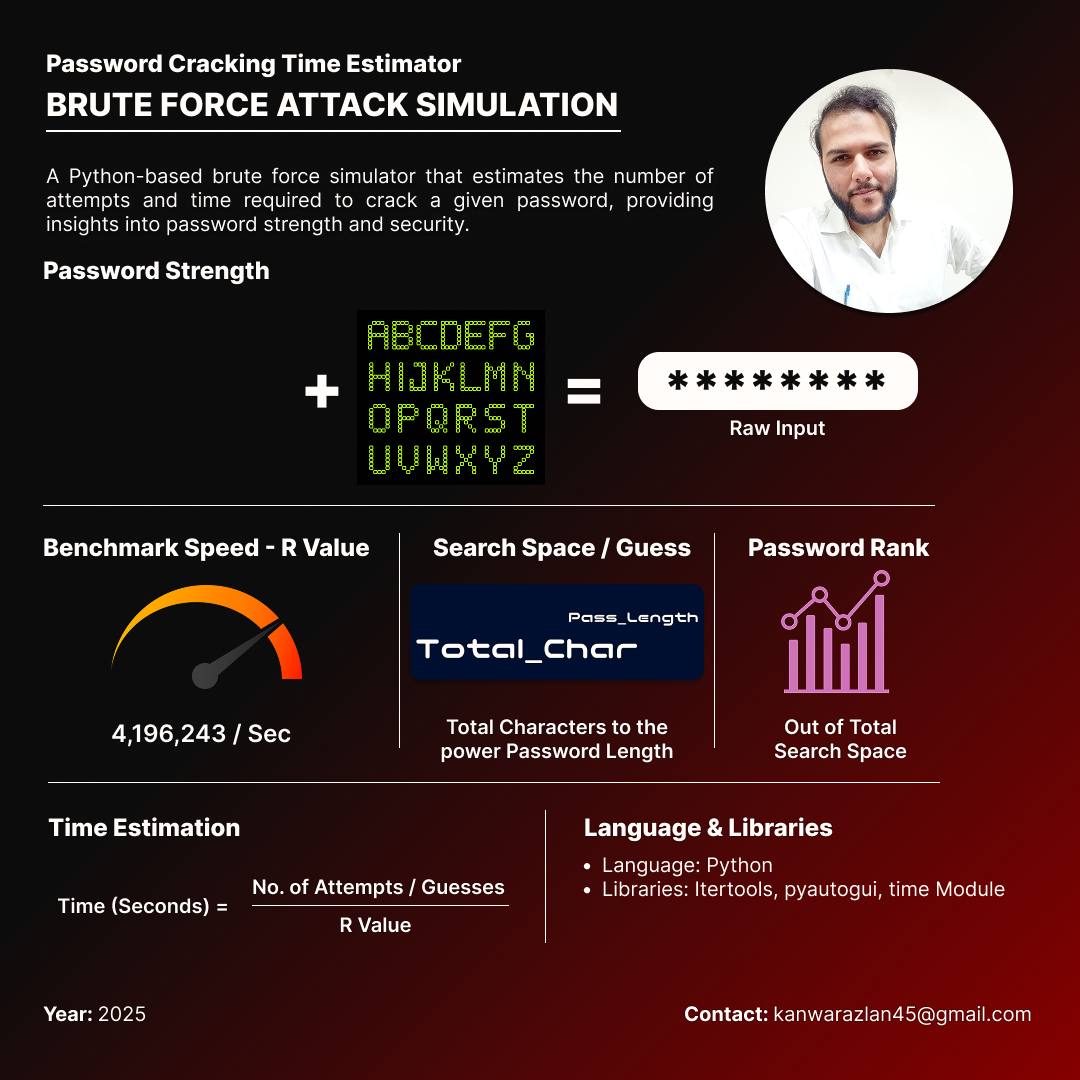
A Python-based brute force simulator that estimates the number of attempts and time required to crack a given password.
A simulator which provides insights into password strength and security.
Overview:
Password strength can be a big challenge as the attackers can guess them easily. No matter how strong your password is, if it exhibits a specific pattern or redundant data, it becomes more easy for an attacker to bring that upfront. To protect and defend against such attacks, It's important to know the strength of your own passwords before the attacker. At least we can try to make our passwords hard to guess. This project aims to build a brute force attack and the time it takes to brute force any password.
Procedure:
Define character set. Include all possible characters for guessing. Convert this into a usable form for iteration.
Take password input from the user. Prompt user securely (without showing input on screen) using pyautogui.password().
Start the timer. Record the start time using time.time().
Brute-force guessing loop. Iterate through possible guess lengths (from 1 to the length of the password). For each guess length, generate all possible combinations of characters using itertools.product(). Convert each combination into a string ("".join(guess)). Keep track of number of attempts.
Password match check. Compare each generated guess with the actual password.
If matched. Record the end time. Calculate total elapsed time (end – start). Print the cracked password, total attempts, and time taken.
Description:
This project aims to build a brute force attack simulator. We have used multiple python libraries such as itertools, pyautogui and time module which estimates the time required to crack a password. The attack simultaneously starts the timer and try to guess the password, if matched, it calculates the estimated time taken and displayed on the input. The password which we have tested generated on the random input combination of alphabets, special characters and numbers.
Skills:
Cryptography
Attack Vectors
Python
Mitigation strategies
Problem Solving Ethical Hacking Mindset
Network Fundamentals
Reference:
To get the full access of documents and the resources of the project, please visit the link below:
Note: These membership cards are not official cards from the organization or any community. These are custom made to visualize and enhance the user experience.
Problem Solving | Write technical reports | Manage personal professional development | Develop strategy | coordinate with the team | communication | Leadership
Established and leading a cybersecurity community focused on collaborating, sharing news updates, job opportunities and improving cyber defense. Connect with cybersecurity professionals and make collaborative discussions to promote security education among students and professionals.
Funded Research Project
Cybersecurity Lead
Led a funded Research Academic Project with a 5 members team including software developers and supervisors on Zero-day Attack Detection using Ensemble Unsupervised Framework in network traffic. This project is funded by FAST National University, Pakistan.
Ethical Hacking Lab
Host
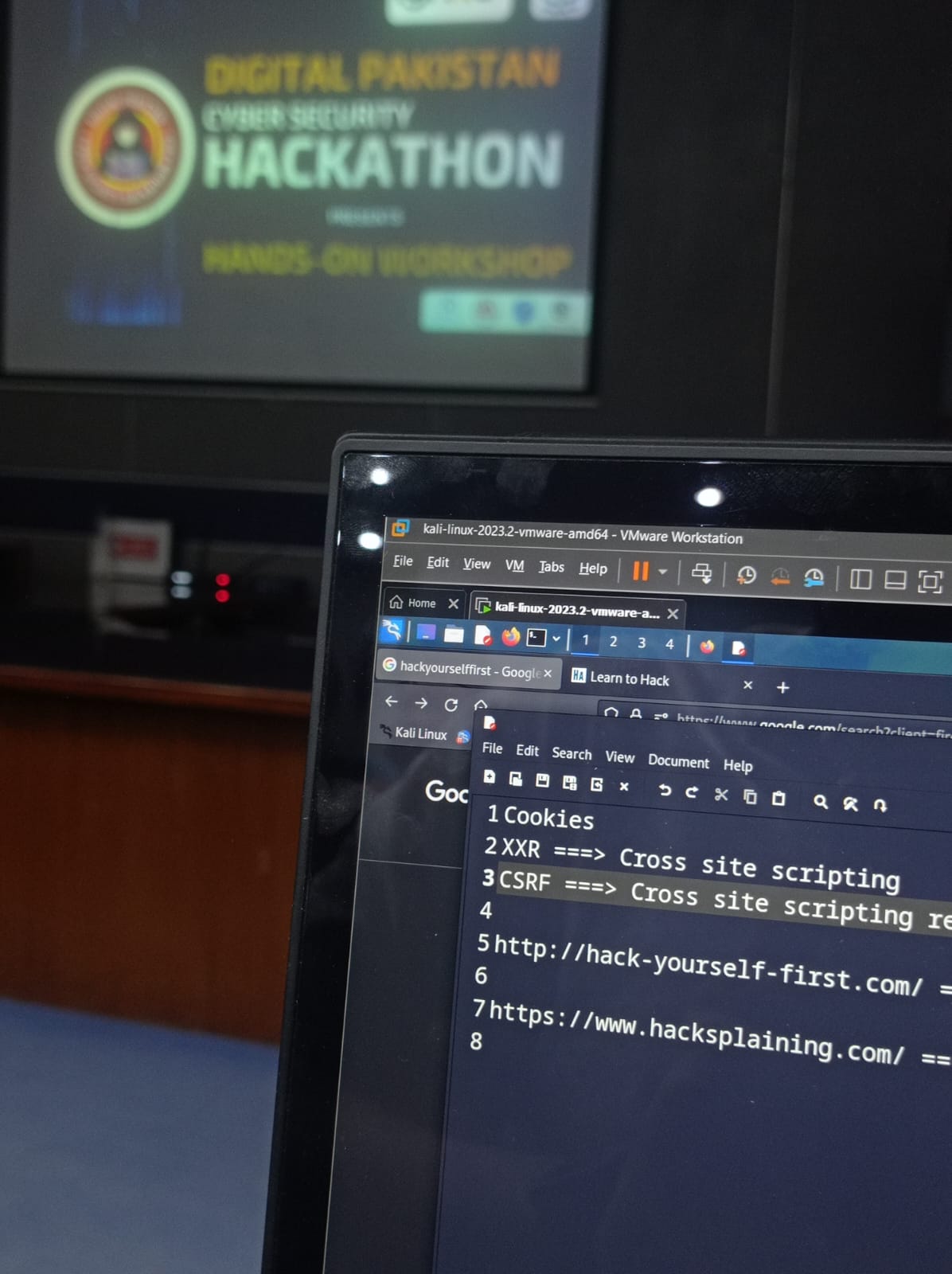
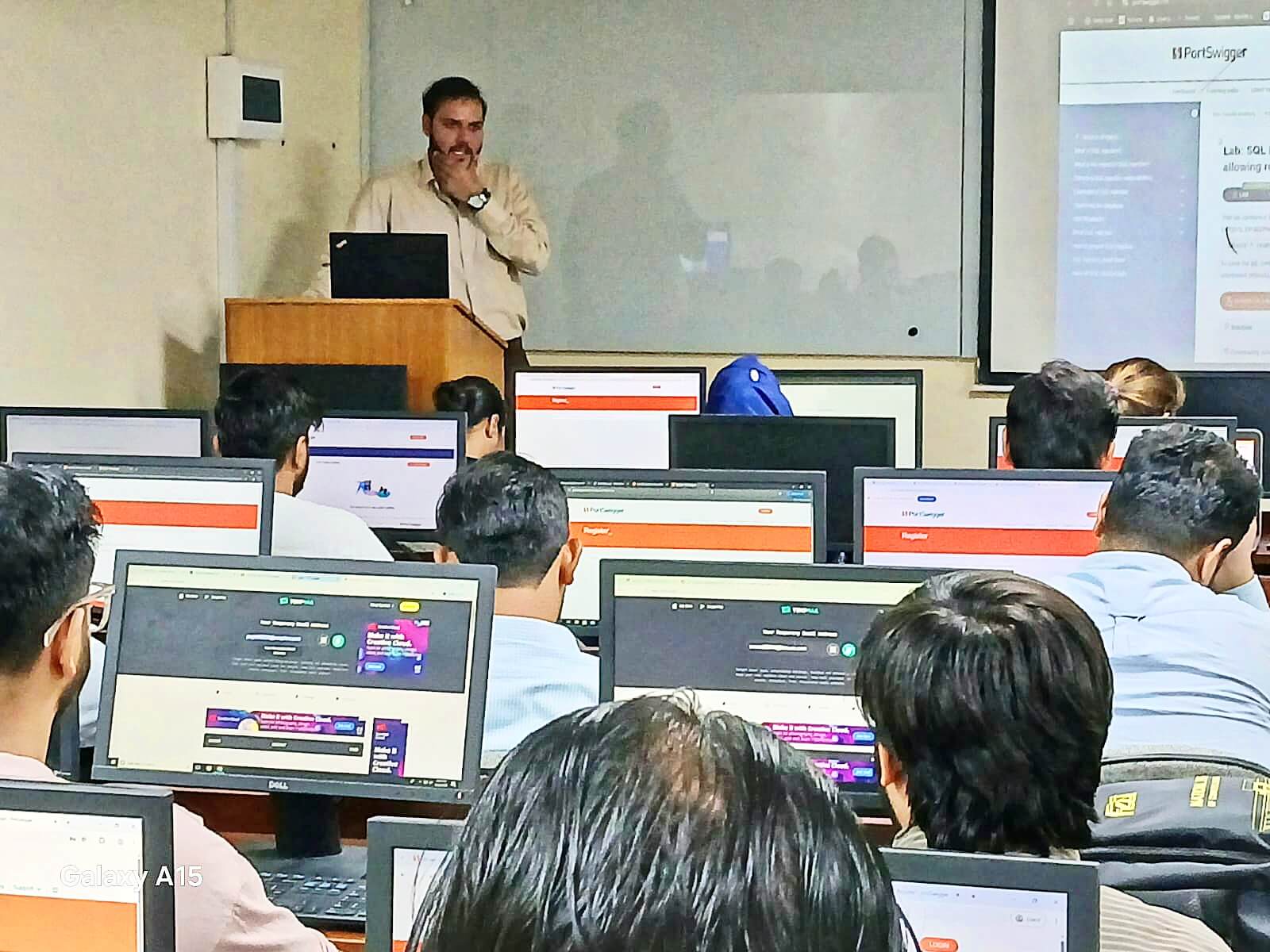
Conducted a Lab Session on Ethical Hacking Focusing on Phishing Attacks and SQL Injection at FAST National University, Pakistan. This Session is a part of a Master's Coursework on Ethical Hacking.
Phishing Awareness and Quiz
Host
Hosted an online Awareness Training on Phishing Attacks and it's importance. It covers phishing attacks tactics, techniques used by attackers, risks and criticality and ways to protect and defend from such incidents. The Training also includes Google Phishing Quiz session.
Cybersecurity Zone
Lead
Leading a Cybersecurity Research Lab named "Cybersecurity Zone" at NUST University, Islamabad. Serving as the primary liaison, Curate and disseminate high-level technical intelligence, Responsible for maintaining project timelines and organizational agility, Directing a high-level research initiative.
Mr. Kanwar Azlan
Lead Cybersecurity
Hey! This is Me.
Curiosity is what drives me! It helps me to stay adaptive and a quick learner. Cybersecurity is also one of the field that thrives constant evolution. It demands up-to-date Knowledge and an adaptive mindset.
I serve both with a 'Cybersecurity Research Associate' by profession a Security enthusiast by passion. My 'Master's In Cybersecurity' (MS CS) motivates me to excel and contribute to this field. I prefer collective growth over individuality.
I believe true progress in cybersecurity comes from collaboration, sharing knowledge and supporting peers. So I worked on this idea and in 2023, Launched a community platform 'Cyber Community 01'. It is a professional cybersecurity platform, build to share news updates, job opportunities and free certified courses to help the cybersecurity community.
For more details, please visit "Portfolio" Page in the main menu.
Network Security || AI & ML for cybersecurity || Security Operation Center (SOC) || Risk and Vulnerability Assessment || Penetration Testing || Data Protection and Privacy || Industrial Control Systems (ICS) || Enterprise Networks
Cyber Community 01
Mr. Kanwar Azlan
Founder & CEO
The online community serve as a single point of contact to all the cybersecurity resources including news updates, job opportunities, networking and connections, free certified courses, mentorship and much more. It was founded in 2023 by Mr. Kanwar Azlan with a mission to share, connect and build a cybersecurity community with like-minded peoples and grow as a team.
Initially it started with a WhatsApp community, but as this community grows exponentially, Mr. Kanwar Azlan decided to expand this initiative to the next level on LinkedIn Platform. Currently the official cyber community 01 is running successfully on a LinkedIn page.
Why you should Join Us?
Get latest cybersecurity news updates from IBM, Google, WhatsApp, Microsoft, Cisco, EY, The Hacker News etc.
Build network and connections
Share and Collaborate with like-minded people, mentors and professionals
Get job opportunities in cybersecurity field.
Get access to free certified courses from well-known firms and tech giants like IBM, Cisco, Google, Microsoft, EC Council etc.
Get one-to-one mentorship from industry professionals
Real-Time Detection and Prediction of Zero-Day Attacks In Encrypted Network Traffic Using Ensemble Unsupervised Learning
This Master's Thesis Project has been approved a Research Funding Grant by FAST National University of Computer and Emerging Sciences. We as a five members team, worked on this project including supervisors and software developers.
Team Members
Mr. Kanwar Azlan
Cybersecurity Research Associate
Asst. Prof. Dr. Fahad Samad
Assistant Professor - Supervisor
Prof. Shoaib Raza
Professor - Co-Supervisor
Mr. Noufal Ehab
Software Developer - AI and ML
Mr. Zain Ali
Software Developer - Cybersecurity
Funded Research Support Grant - FRSG
Funding Body
FAST National University of Computer and Emerging Sciences, Pakistan.
Real-Time Detection and Prediction of Zero-Day Attacks In Encrypted Network Traffic Using Ensemble Unsupervised Learning
Project Summary
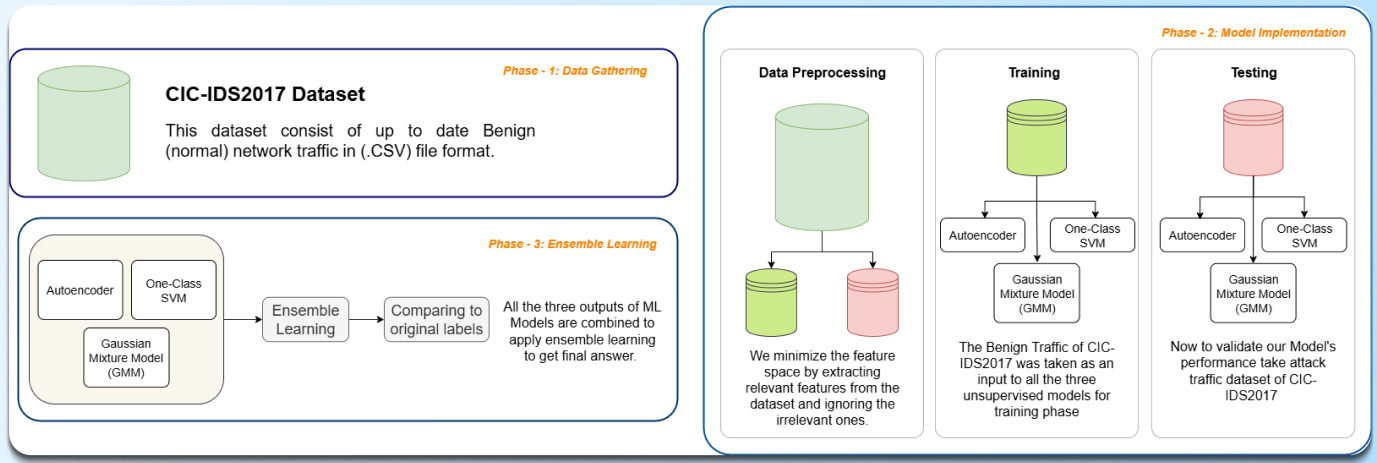
The extensive attack surface of cyber security, covers both known and unknown attacks. These attack contains a wide range of unknown malicious patterns that can be hard to detect from traditional machine learning models. To be precious about this, The traditional machine learning models like supervised or deep learning, uses signature and pattern based detection which still poses a threat to unknown or zero-day attack vectors. Although they contain a high amount of accuracy in detecting zero-day attacks but the question is, what if the attack is still unknown or the patterns are not recognized by the model beforehand? To solve this issue, we have proposed unsupervised learning framework as a threat detection model specifically for detecting zero-day attacks in network traffic. Unsupervised learning does not have labelled data, which itself makes it suitable for zero-day (unknown) attacks. In addition to this, we have done classification of the detected attacks as well so that we can categorize the class of the attack like DDOS, Slowris, Web attacks etc. We have used state-of-the-art models like Autoencoder, One-Class SVM and Gaussian Mixture Model (GMM) on Benchmark dataset CIC-IDS 2017. After the successful experimentation, we achieved 85% Accuracy rate in detection and prediction of zero-day attacks.
Thesis Project Vs Funded Research Project
This project idea was initially proposed by Mr. Kanwar Azlan as his Master's Thesis Idea in 2024. Later, Asst. Prof. Dr. Fahad Samad (The Supervisor of this project) submitted this idea for a Funded Research Support Grant - FRSG Initiative at FAST National University, Islamabad (FAST University's Headquarter). In 2025 This Master's Thesis Idea got approved a Research Fund Grant and Mr. Kanwar Azlan got appointed as a Cybersecurity Research Associate to Lead this funded research project with a five members team under the supervision of Asst. Prof. Dr. Fahad Samad.
Research Gap
Graph analysis framework which is a deep learning model was used which makes the model less accurate in comparison of unsupervised learning.
Existing encrypted traffic detection methods uses supervised learning which is based on prior knowledge. (e.g. labeled dataset).
Objectives
This project aims to develop an unsupervised learning framework which performs effectively in comparison of traditional machine learning models.
Apart from the traditional machine learning models, we chose the models which works on patterns, behaviors, also on probability based detection technique.
Tracking the behaviors and patterns of the data points and then identify the type of zero-day attack and classify them as a 'Label'.
To prepare a research paper for publication on detecting of zero-day attacks in network traffic using ensemble learning unsupervised framework.
Methodology
Results & Findings
Our model individually demonstrated promising results in detecting zero-day attacks in network traffic with around 80% plus accuracy and overall achieved 75% accuracy with AUC-ROC of 77.5% in detection of zero-day attacks without the need of labeled data. The results of the three models are combined to run an ensemble learning pipeline. Our model individually demonstrated promising results in detecting zero-day attacks in network traffic with around 80% plus accuracy and overall achieved 75% accuracy with AUC-ROC of 77.5% in detection of zero-day attacks without the need of labeled data. The results of the three models are combined to run an ensemble learning pipeline.